Find the place
“Bring up an image of a place where you feel calm and safe. It can be real or imagined.”
A place the client links only with calm. If a real place carries mixed memories, an imagined place works just as well.
A free, fillable script for installing a safe or calm place in Phase 2. Eight steps, from finding the place to testing it with a small disturbance, with the words to say and what to watch for.
Free, no account needed. Fill it in on screen or print it.
The safe or calm place is a resource the client can return to when distress rises. It is usually installed in Phase 2, before any processing, and you can come back to it at closure or whenever the client needs a break.
Many therapists say calm place rather than safe place, because safety can be a loaded word for clients who have rarely felt safe. The steps are the same. Installing it also tells you something: a client who cannot hold any calm place may need more preparation before processing.
Read each line slowly and wait for the client before you move on. If your training uses different wording, use that.
“Bring up an image of a place where you feel calm and safe. It can be real or imagined.”
A place the client links only with calm. If a real place carries mixed memories, an imagined place works just as well.
“What do you see there? What can you hear, smell and feel? Notice the temperature and the light.”
Reflect the details back in the client’s own words. The richer the image, the easier it is to return to.
“As you are there, what do you notice in your body? Where do you feel the calm?”
A pleasant sensation in the body tells you the resource is landing. If the client feels nothing, add detail or try another place.
“Stay with the place and that feeling, and follow the movement.”
Short, slow sets. Ask what the client notices after each one, and keep going only while it stays pleasant.
“Is there a word that fits this place? Think of the word and the place together, and follow the movement.”
One word the client chooses, such as the name of the place or a feeling. It becomes the way back in.
“Now say the word to yourself, and notice how the place and the feeling come back.”
The client brings the place up without your guidance. This is what they will do between sessions.
“Think of something mildly annoying from this week. Notice how it feels. Now bring up your word and your place, and notice what happens.”
Choose something small, never a target memory. Guide the client back to the place until the calm returns.
“Think of something small that bothers you, and bring back the place with your word, on your own this time.”
The same test, led by the client. When it works, the resource is ready for use between sessions and at closure.
Stop the BLS. Use the container for what came up, then choose another place or an imagined one.
If the BLS keeps pulling in other material, practice the place as imagery only, without BLS, and come back to it later.
The opening line EyeMove uses in Adult, Youth and Child mode, with one tip for each.
“Bring up an image of a place where you feel calm and safe. Notice what you see, hear and feel there.”
Let the client choose whether it is a calm place or a safe place.
“Picture a place where you feel calm and safe. What do you see and hear there?”
Let them pick the place, even if it seems ordinary to you.
“Think of a place where you feel safe and happy. It can be real or made up. What’s there?”
Drawing the place first helps many children hold the image.
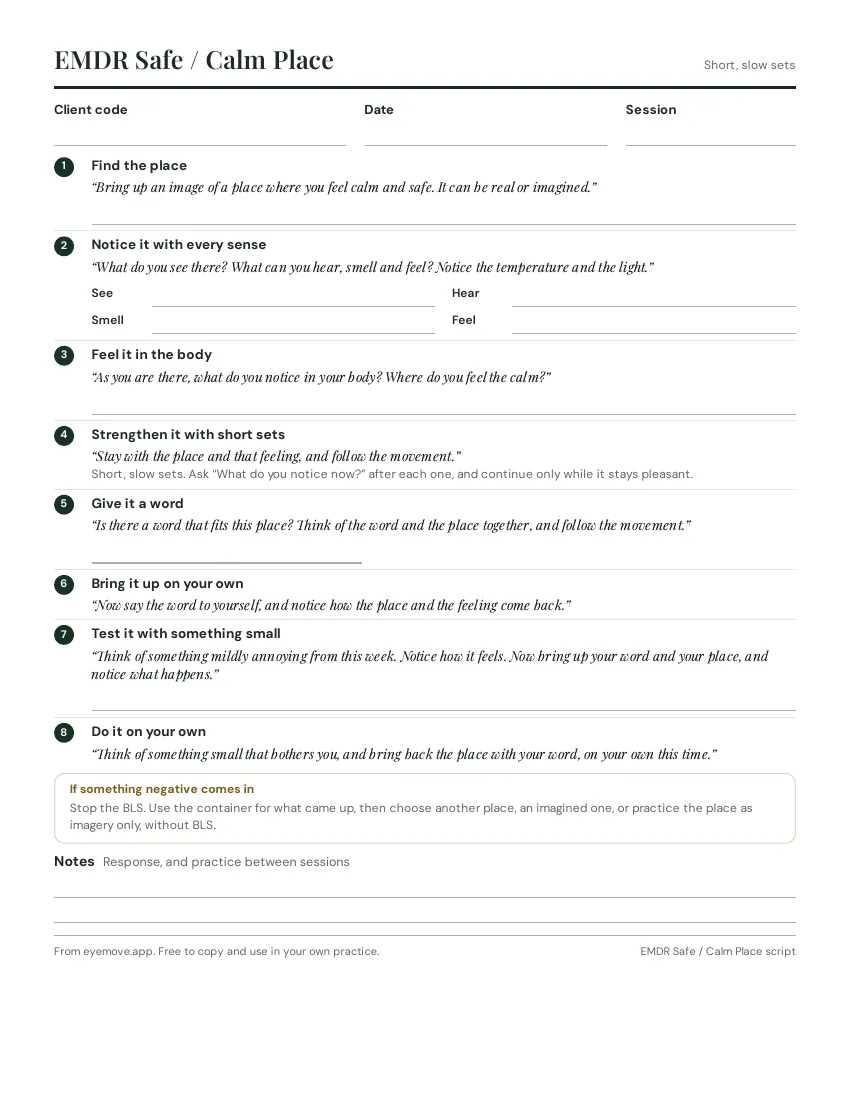
EMDR Safe / Calm Place
Short, slow sets“Bring up an image of a place where you feel calm and safe. It can be real or imagined.”
“What do you see there? What can you hear, smell and feel? Notice the temperature and the light.”
“As you are there, what do you notice in your body? Where do you feel the calm?”
“Stay with the place and that feeling, and follow the movement.”
Short, slow sets. Ask “What do you notice now?” after each one, and continue only while it stays pleasant.
“Is there a word that fits this place? Think of the word and the place together, and follow the movement.”
“Now say the word to yourself, and notice how the place and the feeling come back.”
“Think of something mildly annoying from this week. Notice how it feels. Now bring up your word and your place, and notice what happens.”
“Think of something small that bothers you, and bring back the place with your word, on your own this time.”
If something negative comes in
Stop the BLS. Use the container for what came up, then choose another place, an imagined one, or practice the place as imagery only, without BLS.
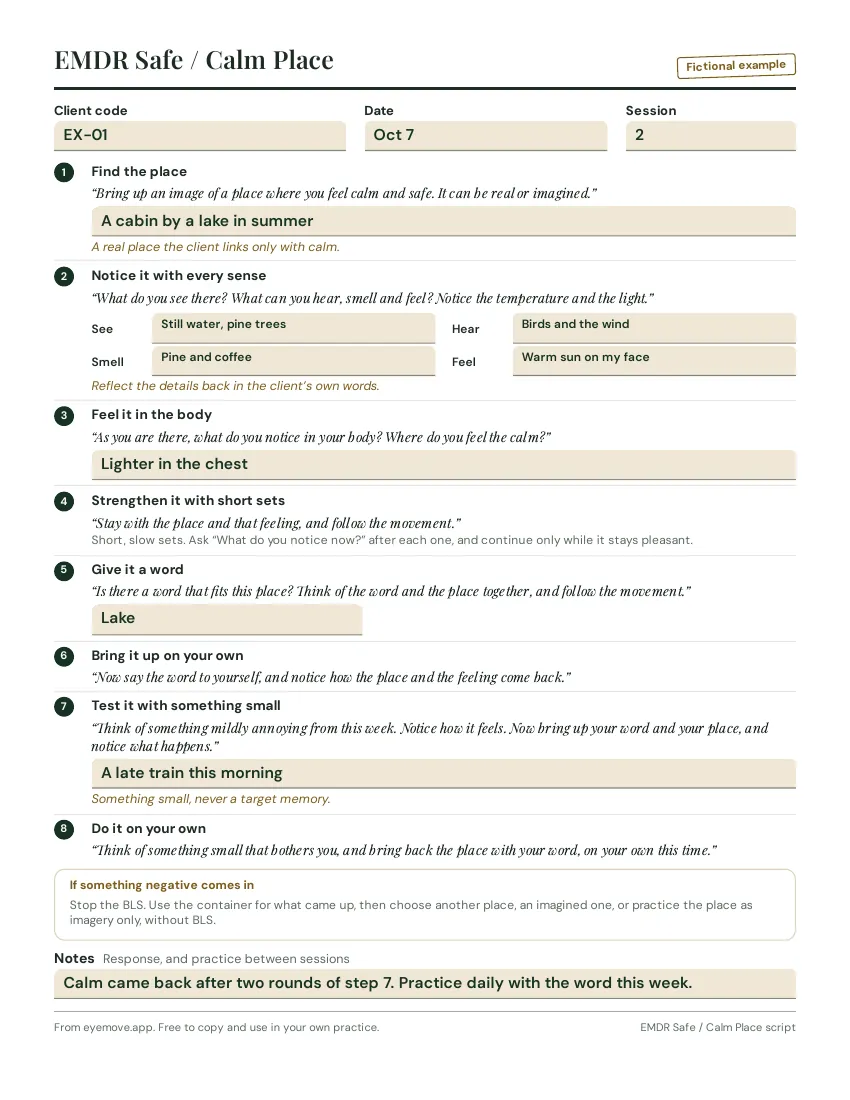
A fictional client in a preparation session, the same client as in our Floatback and Phase 3 examples. The notes in gold explain the choices.
EMDR Safe / Calm Place
Fictional example“Bring up an image of a place where you feel calm and safe. It can be real or imagined.”
A real place the client links only with calm.
“What do you see there? What can you hear, smell and feel? Notice the temperature and the light.”
Reflect the details back in the client’s own words.
“As you are there, what do you notice in your body? Where do you feel the calm?”
“Stay with the place and that feeling, and follow the movement.”
Short, slow sets. Ask “What do you notice now?” after each one, and continue only while it stays pleasant.
“Is there a word that fits this place? Think of the word and the place together, and follow the movement.”
“Now say the word to yourself, and notice how the place and the feeling come back.”
“Think of something mildly annoying from this week. Notice how it feels. Now bring up your word and your place, and notice what happens.”
Something small, never a target memory.
“Think of something small that bothers you, and bring back the place with your word, on your own this time.”
If something negative comes in
Stop the BLS. Use the container for what came up, then choose another place, an imagined one, or practice the place as imagery only, without BLS.
Safe Place is one of the session types in EyeMove, for Phase 2 resourcing. You read the prompts from your phone, and the client follows on their own screen.
Prompts draw out what the client sees, hears and feels in their place.
The BLS is set up for resource work, so the client stays with the calm.
Box breathing, the butterfly hug, 5-4-3-2-1 grounding and the container, on the client’s screen.
Session data is encrypted in your browser and deleted within four hours. Nothing is kept as a client record.
30-day free trial. Cancel anytime.

Reviewed by Bjarne ØverlandClinical psychologist, specialist in psychotherapy, and founder of EyeMoveLast updated October 2026
A Phase 2 resource. The client brings up a place linked with calm, strengthens the feeling with short, slow sets of BLS, links it to a cue word, and practices returning to it on their own.
Either. Many therapists prefer calm place, because safety can be a loaded word for clients who have rarely felt safe. The steps are the same.
Short and slow, so the client stays with the pleasant feeling rather than starting to process. Check after each set, and continue only while it stays positive.
Stop the BLS, use the container for what came up, and choose another place or an imagined one. If BLS keeps bringing in other material, practice the place as imagery only.
Try an imagined place, a calm moment instead of a place, or more sensory detail. A client who cannot hold any calm place may need more preparation before processing.
Yes. Keep the words simple, let the place be real or made up, and let the child draw it if that helps them hold the image.
Yes. The PDF can be filled in on screen in most PDF readers, or printed. No account is needed.
Safe Place is its own session type. Prompts draw out what the client sees, hears and feels, and the BLS runs in short, slow sets. Session data is encrypted in your browser and deleted within four hours.