The quality needed
“What quality in yourself do you need most to handle this?”
Keep it simple and meaningful to the client: strength, stubbornness, patience, clarity. No BLS yet.
A free, fillable script for Resource Development and Installation in Phase 2. Six steps, from the quality the client needs to carrying it into the situation ahead, with the words to say and what to watch for.
Free, no account needed. Fill it in on screen or print it.
Resource Development and Installation strengthens a quality the client needs, such as steadiness or courage. You link it to a memory of mastery and a symbol, and install it with short sets of BLS. It is used in Phase 2, often with clients whose capacity is limited, before processing or ahead of a hard situation.
It is not processing. The sets are short, there is no free association, and you keep going only while the resource gets stronger. RDI was described by Deborah Korn and Andrew Leeds.
Steps 3 to 6 repeat: run another short set while the feeling gets stronger, and move on when it stops growing. These are the same lines as the Resource Installation tool in EyeMove. If your training uses different wording, use that.
“What quality in yourself do you need most to handle this?”
Keep it simple and meaningful to the client: strength, stubbornness, patience, clarity. No BLS yet.
“Think back to a moment when you really felt: yes, I managed that. It can be a big thing or a small detail.”
What matters is the positive feeling of having managed, not the size of it, and not whether it matches the quality exactly.
“Picture that moment. Notice the good feeling it gives you, and where in your body you feel it.”
Short sets only, 6 to 12 passes. Deepen with sensory detail between sets. No free association.
“See if you can find an animal, a symbol, or a person you connect with that quality. Picture it, and notice the feeling it gives you.”
Animals are usually easier than people, since people carry ambivalence.
“Hold that moment again, feel it, and at the same time take in the image of the symbol. Notice what that gives you.”
Let the client draw the symbol in, become part of it, or step into it, whichever fits.
“Keep that feeling, and take it with you into the situation ahead. Picture yourself there, and notice how the feeling changes the way you meet it.”
An anchor can be added here, and a positive cognition can be installed alongside it.
“As you hold that feeling, press your thumb and finger together. That press is now a way back to this.”
Short set, then test it: let the client release, come back to ordinary conversation, and press again.
“Let that go for now. Look around the room, name a few things you can see, and come back to me.”
Stop the BLS, orient to the present, then choose a different resource. A resource that keeps turning usually has a mixed association, for instance a safe figure who was also frightening or absent.
“It does not have to be a big moment. Something small and ordinary works just as well.”
If nothing comes at all, use an imagined figure, a fictional or historical one, or borrow the quality from someone the client admires. Clients with very little adaptive material are telling you where the work is.
Both are Phase 2 resources, but they do different jobs. Many clients get both.
Somewhere calm to return to.
Useful at closure, for breaks during processing, and between sessions.
Safe place scriptA quality to meet something hard with.
Useful before processing with clients whose capacity is limited, or ahead of a difficult situation.
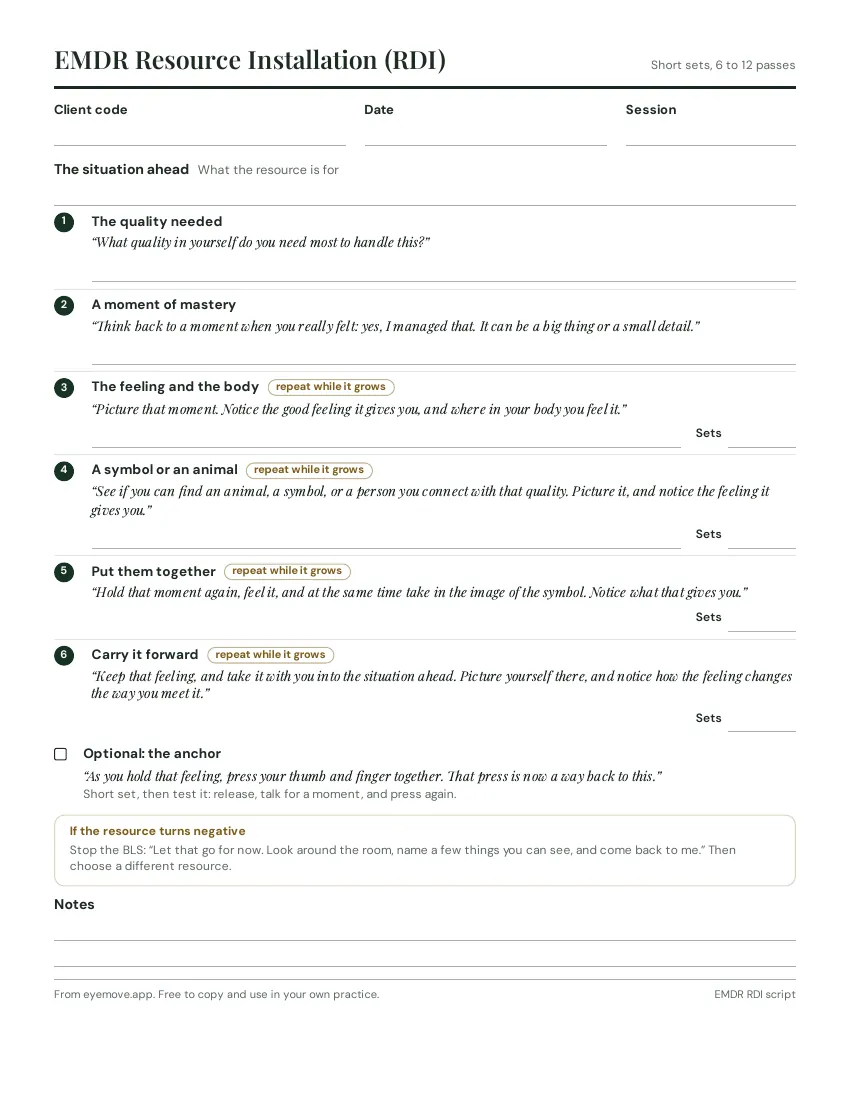
EMDR Resource Installation (RDI)
Short sets, 6 to 12 passes“What quality in yourself do you need most to handle this?”
“Think back to a moment when you really felt: yes, I managed that. It can be a big thing or a small detail.”
“Picture that moment. Notice the good feeling it gives you, and where in your body you feel it.”
“See if you can find an animal, a symbol, or a person you connect with that quality. Picture it, and notice the feeling it gives you.”
“Hold that moment again, feel it, and at the same time take in the image of the symbol. Notice what that gives you.”
“Keep that feeling, and take it with you into the situation ahead. Picture yourself there, and notice how the feeling changes the way you meet it.”
“As you hold that feeling, press your thumb and finger together. That press is now a way back to this.”
Short set, then test it: release, talk for a moment, and press again.
If the resource turns negative
Stop the BLS: “Let that go for now. Look around the room, name a few things you can see, and come back to me.” Then choose a different resource.
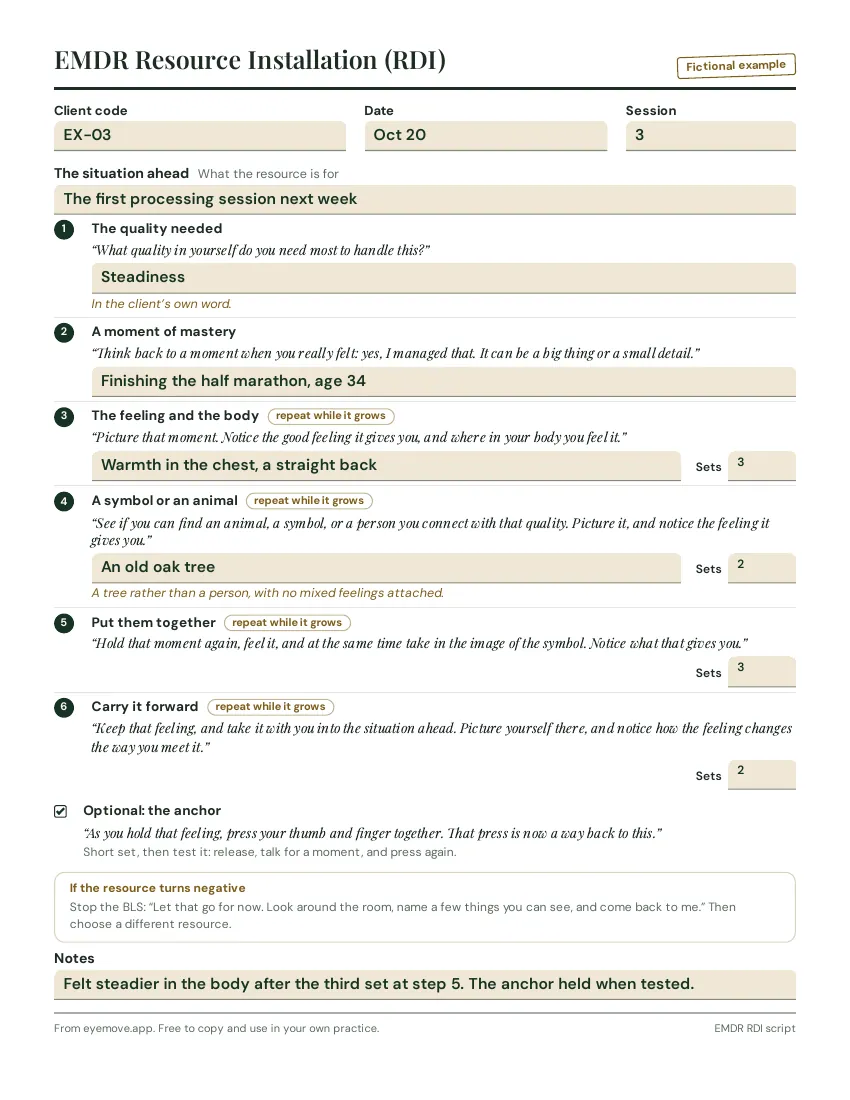
A fictional client getting ready for their first processing session. The notes in gold explain the choices.
EMDR Resource Installation (RDI)
Fictional example“What quality in yourself do you need most to handle this?”
In the client’s own word.
“Think back to a moment when you really felt: yes, I managed that. It can be a big thing or a small detail.”
“Picture that moment. Notice the good feeling it gives you, and where in your body you feel it.”
“See if you can find an animal, a symbol, or a person you connect with that quality. Picture it, and notice the feeling it gives you.”
A tree rather than a person, with no mixed feelings attached.
“Hold that moment again, feel it, and at the same time take in the image of the symbol. Notice what that gives you.”
“Keep that feeling, and take it with you into the situation ahead. Picture yourself there, and notice how the feeling changes the way you meet it.”
“As you hold that feeling, press your thumb and finger together. That press is now a way back to this.”
Short set, then test it: release, talk for a moment, and press again.
If the resource turns negative
Stop the BLS: “Let that go for now. Look around the room, name a few things you can see, and come back to me.” Then choose a different resource.
Resource Installation is one of the session types in EyeMove, for Phase 2. You read the script from your phone, and the client follows on their own screen.
Each step shows the line to read and a short note, with room for the quality, the memory and the symbol.
The repeating steps count your sets, and you move on when the feeling stops growing.
A warm glow grows a little with each set, and starts again when you move on.
If the resource turns negative, one tap brings up the words to orient the client, and you choose another resource.
Session data is encrypted in your browser and deleted within four hours. Nothing is kept as a client record.
30-day free trial. Cancel anytime.

Reviewed by Bjarne ØverlandClinical psychologist, specialist in psychotherapy, and founder of EyeMoveLast updated October 2026
Resource Development and Installation. In Phase 2, you help the client find a quality they need, link it to a memory of mastery and a symbol, and strengthen it with short sets of BLS, so they can meet processing or a hard situation with more capacity.
They do different jobs. A safe place gives the client somewhere calm to return to. RDI strengthens a quality the client needs to meet something hard. Many clients get both.
Short, 6 to 12 passes, with no free association. Run another set while the feeling gets stronger, and move on when it stops growing.
Stop the BLS, orient the client to the room, and choose a different resource. A resource that keeps turning usually has a mixed association, such as a figure who was also frightening or absent.
Something small and ordinary works just as well. If nothing comes at all, use an imagined, fictional or historical figure, or borrow the quality from someone the client admires.
Animals are usually easier, since people tend to carry ambivalence. A symbol works well too.
Yes. The PDF can be filled in on screen in most PDF readers, or printed. No account is needed.
Resource Installation is one of the session types. You read each step from your phone, run another set while the feeling grows, and a warm glow on the client’s screen grows a little with each set. Session data is encrypted in your browser and deleted within four hours.