When EMDR processing gets stuck
Several sets in a row, and nothing moves. This guide helps you tell what kind of stuck it is, check the client’s capacity first, and choose the smallest intervention that gets processing going again.
Use it as a map, not an algorithm. Your training and your read of the client come first.

Reviewed by Bjarne Øverland, clinical psychologist, specialist in psychotherapy
October 2026
Is it really stuck?
Stuck describes what you see, not what is going on underneath. Before you intervene, look at what has happened across the last two or three sets, and at more than the SUD.
Slow processing
The SUD moves little, but the image, the emotion or the body sensation keeps changing.
Keep going. Change shows up in more places than the SUD.
Plateau
The charge has dropped and nothing new arrives.
The channel may be finished. Return to target and take a SUD.
Looping
The same content comes back set after set, with the same or rising distress.
Processing is blocked. Change the mechanics, then consider an interweave.
Nothing comes up
The client reports “nothing” over several sets.
It can mean several things. More on that further down.
Flooding
Distress rises fast, and the client loses contact with the room.
A capacity problem, not a blocked network. Restore dual attention first.
Talking about it
Insights and explanations, but no felt change.
Often a defense, and the client may still have capacity. Bring attention back to the body.
Two to three sets with the same content and no change in affect or SUD is a common working threshold for looping. Treat it as a rule of thumb, not a cutoff.
Start with the mechanics
Changing the bilateral stimulation is the least intrusive option. It often breaks a loop without adding any content of your own, and it keeps the client’s processing in charge.
- Change directionHorizontal to diagonal, or the other way round.
- Change speed or set lengthLonger sets for a slow build, shorter sets when distress climbs.
- Switch modalityFrom eye movements to tactile or auditory stimulation, or back.
- Narrow the focusAsk the client to notice only the body sensation during the next set.
If two or three variations do not help, check capacity and look for the block. In EyeMove the BLS controls stay available the whole time, so you can change the set without leaving stuck support.
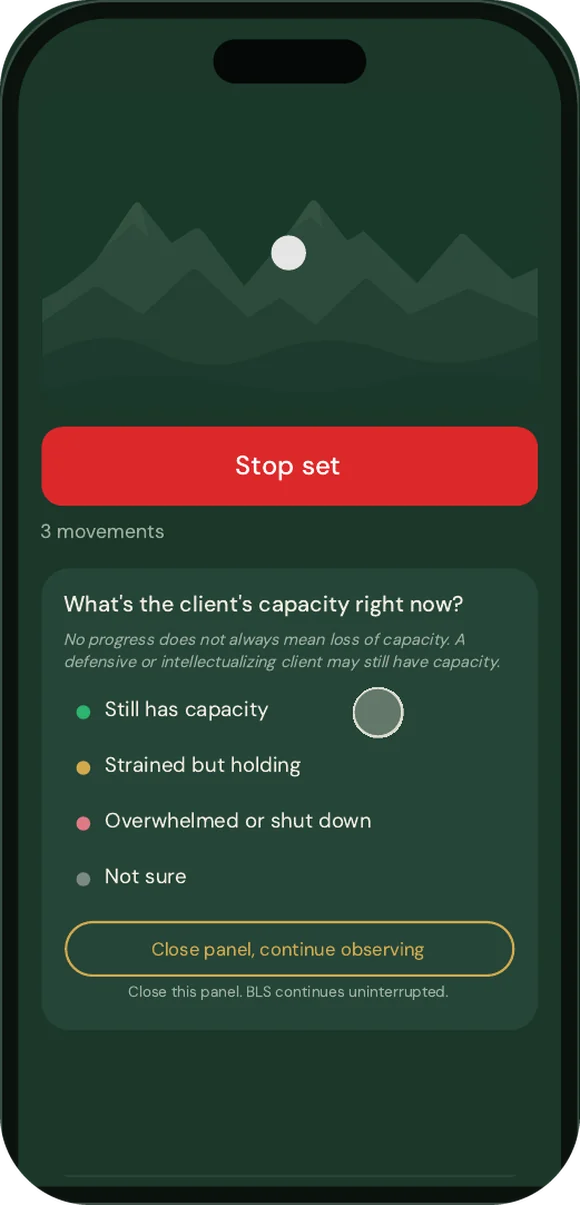
Check capacity first
No progress does not always mean loss of capacity. A defensive or intellectualizing client may still have plenty. Decide where the client is before you choose what to do, because the same interweave that helps one client can push another out of their window of tolerance.
Still has capacity
Present, able to describe what they notice, and distress within a tolerable range. You can lean in: name the block and offer an interweave.
Strained but holding
Working hard, but still in contact with you and the room. Keep sets shorter, check in more often, and keep any interweave small.
You can also choose light support: smaller steps, shorter sets, brief anchoring.
Overwhelmed or shut down
Flooded, numb, far away or losing dual attention. Stop pushing on the memory, ground and orient to the room, and consider closing the session as incomplete.
Hyperaroused. Narrow the focus and slow down.
Hypoaroused. Bring the client back to the room first.
Not sure
Ask. “Where are you right now, here or there?” A short check costs less than a wrong guess.
Numbness, dizziness or fog can be signs of dissociation. Check dual attention: can the client stay present and describe what they notice? Nausea is often part of the memory, and can be processed if the client stays present.
Name what may be blocking
When the client has capacity and processing still loops, the block usually falls into one of five groups. Each points to a different kind of interweave. The prompts below are examples, so adapt the words to your client.
Stuck belief or meaning
The same conclusion about the self keeps returning: it was my fault, I am not safe, I am bad, I could not do anything.
- Responsibility
Who was the adult in that room?
- Safety
Where are you now? Is it still happening?
- Self-worth
If this happened to a child you care about, what would you think of that child?
- Helplessness
You couldn’t stop it then. What can you do now?
- Responsibility
Defensive or controlling
Smiling, explaining, trying to get it right, or keeping the feeling at a distance.
Do you notice that you smile when you talk about him?
You’re telling me what he did. What do you feel?
What would happen if you didn’t have to get this right?
Somatic fear or symptom avoidance
Somatic fear
The client is afraid of the feeling itself, or of a sensation in the body, and pulls away from it.
What happens if you just let it be there for a moment?
Notice the sensation, and notice that you are here with me.
Where does it start in your body?
Target or NC mismatch
A target that does not quite fit
Weak activation, a focus that drifts away from the memory, or an image that was never clear.
- Back to target
When you think of the original memory now, what do you notice?
- Blocking belief
What would have to be true for this to be completely resolved?
- Feeder memory
When do you first remember feeling this way?
- Back to target
Holding back a feeling
A feeling is close but does not come through, or it comes without anything shifting.
Start with what is already there: help the client get closer to the feeling they have named before looking for another. Sometimes it has been felt, and something else needs room. Sadness tends to open through what was lost, anger through the body. Keep any impulse in imagination, one sentence, then BLS. If the client has not named the feeling, do not name it for them; invite it through the body.
What does the sadness want to do?
When you say you’re angry with them, how do you notice it in you right now?
Is there anything else there too, alongside it?
Use the interweave, then step back
An interweave gives processing what it is missing. After that, the client’s own processing should take over again. Choose it by what is missing:
Responsibility confusion
A question that separates the child’s role from the adult’s.
Missing information
Brief education, for example about freeze responses or what children can realistically do.
Missing perspective
What the client would say to a child in the same position.
Blocked adult resources
Bring in the competent present self or a trusted figure.
Getting back out
Keep the interweave to one or two sentences, then say “Go with that” and start the next set. If a dialogue runs for several turns without BLS, you have drifted into talk therapy. Start the next set on whatever the client just said, rather than finishing the discussion first.
Testing for a blocking belief or a feeder memory takes under a minute if you resume BLS right after. The derailing happens when you start exploring the answer instead of processing it.
Use the client’s own words where you can. And if a new feeling comes up after the interweave, that is processing. Often “Go with that” is enough.
Read the response
After the set, ask:
“Take a breath. What do you notice now?”
Then decide which of three it is.
Moving
Something new: an image, a thought, a feeling. Go back to standard processing.
Activated but connected
A strong feeling or body activation, while the client stays present. This is processing. Add nothing, and keep the sets going.
Still stuck
The same content, or the client has lost contact. Check capacity again before you choose anything else.
If the client stays strongly activated for several sets with the same content each time, look again. It can be a loop at high intensity.
When nothing comes up
Several sets of “nothing” can mean very different things. Look at the client as well as the words.
The client is calm and settled, and nothing new arrives.
The channel may be finished. Return to target and take a SUD.
The client seems unsure what to report.
Remind them that anything counts: an image, a thought, a feeling, a sensation, or nothing at all.
A quick “nothing”, eyes away, a change of subject.
Possible avoidance. Name it gently, or ask what they notice in the body.
Far away, glazed, slow to answer.
Possible dissociation. Orient to the room and restore dual attention before more sets.
Calm, but the memory feels flat.
The target may no longer be active. Bring back the image, the negative cognition and the body location.
An example
A fictional client processes the argument with their father at 15, with the negative cognition “I am worthless” and a starting SUD of 8. It is the same client as in our Phase 3 example.
- Sets 1 to 4
SUD 8 to 5. New details come up: the kitchen, the sound of the door, then anger.
- Sets 5 to 7
SUD stays at 5. The same thought returns each time:
I should have kept my mouth shut.
Set 7 is diagonal and slower, with no change. - Capacity
Still has capacity. The client is present, can describe what they notice, and the distress is steady rather than rising.
- Block
A stuck belief in the responsibility theme, even though the negative cognition is about self-worth.
- Interweave after set 7
When a fifteen-year-old speaks up, whose job is it to stay calm?
The client answers:His. He was the adult.
Then:Go with that.
- After set 8
Activated but connected: anger at the father, then sadness. No further interweave. SUD 5 to 3 by set 11.
- Closing
Time runs out at SUD 3. The session closes as incomplete with the container exercise, and the last thing the client said is noted as the entry point for next time.
SUD across the session
Fictional example
When to close the session instead
Stuck is not always something to fix inside the session. If capacity drops, or time runs out, closing well matters more than pushing on.
Stop the BLS, tell the client the session is ending with the work unfinished, and that processing may continue between sessions. Skip the installation and the body scan, since installing a partial positive cognition does not help, and the body scan is a completion check. Use containment, a calm place, or whatever stabilization the client has from Phase 2.
Note exactly where you stopped, including the last thing the client said. That is your entry point next session. The client should be able to leave, travel home and manage the rest of the day. If they cannot get there in the time you have, that tells you something about target size and preparation for next time.